

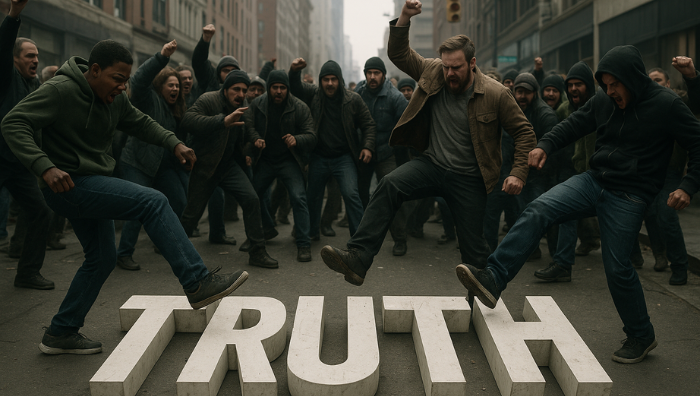
In the digital age, we are witnessing a troubling suspicion: that truth may be dying—or already dead. AI-generated content floods our feeds, social media amplifies speculation, and even traditional news often slants opinion over fact. This begs the question: in a world drowning in words, can we still find truth?
The AI Infusion: A Dead Internet?
The so-called “Dead Internet Theory” suggests that a growing portion of online content is created by AI—not people. This isn’t just about automation; it’s about authenticity being replaced by algorithms. The concern is not whether content is accurate, but whether it’s real at all. As the presence of synthetic voices and AI-generated news grows, our ability to distinguish signal from noise becomes harder than ever.
Social Media and the Death of Truth
Social media was designed to democratize information—but instead, it often distorts it. The platforms reward engagement, not accuracy. Outrage, emotion, and shock go viral far more than sober analysis. Misinformation spreads faster than truth. As a result, conspiracy theories and half-truths thrive, while credible journalism struggles to keep up.
The public sphere has been fragmented into echo chambers, where users are fed content that reinforces what they already believe. When everyone has their own version of “facts,” public discourse becomes tribal, and consensus becomes nearly impossible.
Traditional Media’s Erosion
Even traditional journalism—once the trusted guardian of truth—has not escaped this shift. News outlets now often prioritize speed over verification, and many stories blur the lines between reporting and commentary. The rise of infotainment and opinion-based programming has created confusion about what constitutes fact.
Moreover, some media organizations give equal weight to fringe theories in an effort to appear balanced, a practice known as “false balance,” which misleads audiences into thinking there’s legitimate debate where there isn’t. This has created a crisis of confidence in institutions once relied upon to interpret the world.
Deepfakes and the Reality Crisis
Adding to this, new technologies like deepfakes—AI-generated synthetic images, audio, and video—make it easier than ever to fabricate reality. Videos can now be convincingly altered to make someone say or do something they never did. This doesn’t just deceive individuals—it undermines our collective sense of what’s real.
With each viral deepfake or false tweet, the public becomes more cynical. Even real events are now met with suspicion. If anything can be faked, how can anything be believed?
What It Means
The deeper issue is that our shared sense of reality is eroding. Truth isn’t just under attack—it’s being replaced by a choose-your-own-adventure of belief systems, guided by algorithms. This has profound consequences for democracy, education, journalism, and community.
If people no longer agree on basic facts, how can we solve real-world problems like climate change, health care, or injustice? If truth is dead, reasoned debate becomes impossible—and all that’s left is manipulation and noise.
Can Truth Be Resurrected?
Despite the dire landscape, the answer is not to give up on truth—but to fight for it.
We must invest in media literacy that helps people identify credible sources and question what they see. We must hold tech platforms accountable for the content they host and amplify. Journalists must recommit to accuracy, depth, and clarity—and we, as consumers, must reward substance over sensationalism.
Reclaiming truth won’t be easy. But it starts with asking better questions, valuing slow thinking over hot takes, and choosing reality over convenience.
Because the truth, while fragile, still matters. And in a world bent on blurring the lines, choosing to believe in it—and fight for it—may be one of the most radical acts we have left.
References
- Steven Brill, The Death of Truth – Vanity Fair
- “What’s a Fact, Anyway?” – The New Yorker
- “Social Media and the Death of Truth” – ITPro
- “When the Truth No Longer Matters” – Forbes
- “The Dead Internet Theory” – UNSW Newsroom
- “Yes, Kate Is a Victim of a Deepfake World” – The Australian
- “Trouble with Truth Decay” – LSJ Australia
- “False Balance” – Wikipedia
- “Pink-Slime Journalism” – Wikipedia
- “Filter Bubble” – Wikipedia